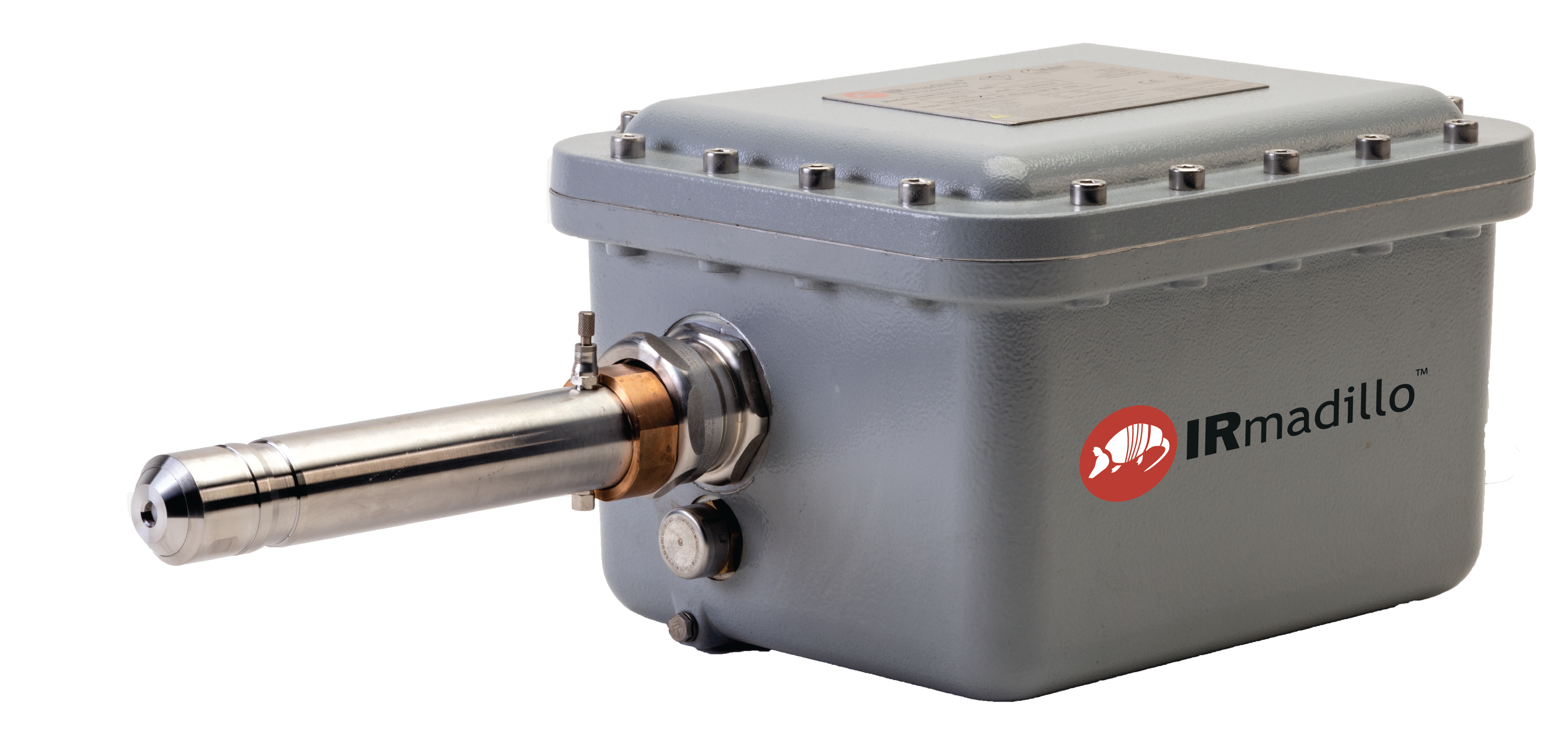
Real-time reaction monitoring in harsh manufacturing environments has been made easy by the IRmadillo FTIR spectrometer manufactured by Keit Industrial Analytics. The IRmadillo is an in situ spectrometer that is highly vibration resistant, and designed for extreme indoor and outdoor conditions. Some of the key features are:
- Real-time reaction analysis without the hassle: no fibre-optic cables between probe and the analyser, nor any remote sampling required.
- Vibration tolerant: a solid-state design resulting in extreme vibration tolerance.
- Mid-infrared spectrum analysis providing continuous process monitoring of liquids.
- Low costs of ownership: minimum to no recalibration or maintenance required.
- Long-term stability.
- Compact size: mounts directly onto – or in line with – manufacturing vessels and process lines.
The IRmadillo static-optics FTIR analyser is able to accurately measure liquids, slurries & emulsions even with particulates in the monitoring stream.
An ‘evanescent wave’ of light on the surface of the ATR (Attenuated Total Reflectance) probe interacts strongly with the liquid under analysis but not the bubbles and/or solids.
The ATR method of sampling has a significantly shorter path length than transmission probes. This means ATR instruments can measure aqueous processes well, and it is no longer the case that ‘FTIR doesn’t work in water’. Choice of ATR and dip probe materials compatible for a wide range of operating environments.
How does the IRmadillo compare to Near Infrared (NIR)?
NIR reflectance probe: In pure liquids, light is sent out through the sample and reflected off the mirrored surface back into the probe for measurement. The long path length allows for lots of signal – critical to NIR performance. Solids or bubbles will interfere with the light path causing issues with measurement.
Although NIR can be suited for simple measurements, it is less information-rich compared to FTIR (mid infrared), and sometimes will not give the level of information required to monitor an application accurately. NIR looks at overtones and combination vibrations of molecules, which means it can struggle to differentiate between very similar molecules. The key is to know which technique is right for you.
If you require IECEx and ATEX certification for hazardous area applications click here.